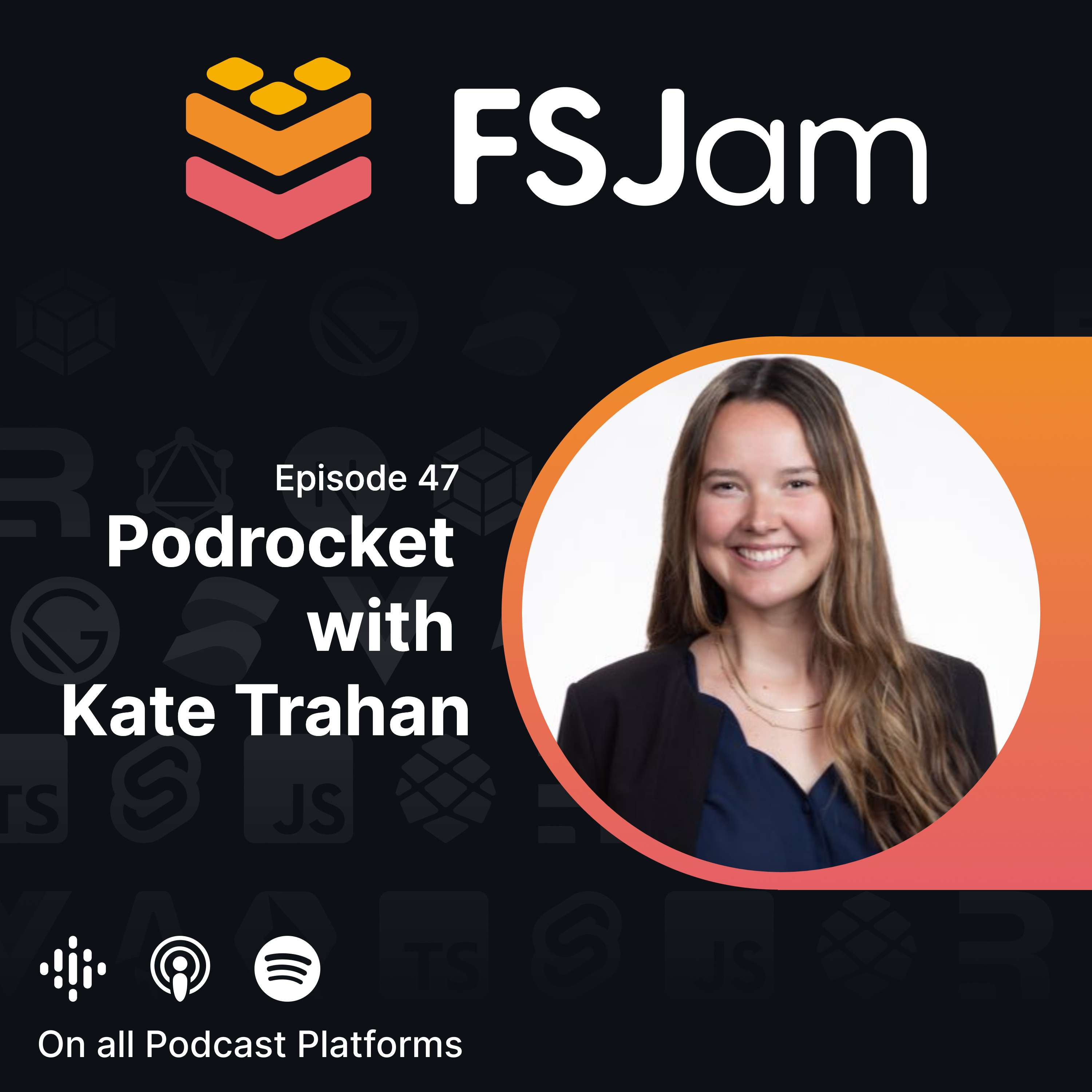
Podrocket with Kate Trahan
Pod Rocket and FSJam hosts swap stories about starting their podcasts, preparing for episodes, building community, and navigating trends in dev tools.
Episode Description
Pod Rocket and FSJam hosts swap stories about starting their podcasts, preparing for episodes, building community, and navigating trends in dev tools.
Episode Summary
In this crossover episode, Pod Rocket host Kate Trahan sits down with FSJam hosts Anthony Campolo and Christopher Burns to compare notes on running web development podcasts. The conversation traces how each show got started — Anthony's music background and prior podcasting experience helped launch FSJam, while Kate and the LogRocket team experimented their way from GarageBand edits and SoundCloud uploads into a twice-weekly production. The hosts share entertaining stumbles along the way, including Chris unknowingly speaking into the wrong side of his microphone for dozens of episodes. They discuss the podcasts that shaped them as listeners and creators, from Software Engineering Daily to ATP, and how those influences carry into their own hosting styles. A key difference emerges around preparation: Kate does extensive research and builds outlines for every guest, while Anthony and Chris rely on their hands-on experience with the tools they cover. The group explores community building, acknowledging that Discord servers often become ghost towns without sustained, genuine engagement. They also examine trends in developer tooling, the challenge of measuring podcast ROI, and the uniquely decentralized nature of podcast distribution. The episode closes with reflections on open-source business models and plans for future collaboration.
Chapters
00:00:00 - Introductions and Podcast Origins
Kate opens the crossover episode by introducing herself as host of Pod Rocket, then welcomes Anthony Campolo and Christopher Burns from FSJam. Anthony explains that FSJam grew out of the Redwood JS community and gradually expanded to cover a curated set of full-stack and Jamstack projects, while Chris recalls the moment he created the FSJ brand with its distinctive pink-and-white aesthetic. Both note that a podcast wasn't their original plan — they initially envisioned a broader community with forums before pivoting to audio.
Kate shares how Pod Rocket emerged from LogRocket's content experiments. After finding success with their blog, the team explored YouTube tutorials before landing on podcasting during the pandemic. She describes early growing pains, including editing the first episode in GarageBand over two days and receiving feedback about audio quality. The hosts bond over the overlap between their guest lists and how each show complements the other.
00:05:12 - Getting Started with Podcasting
Anthony explains how his music degree and years of studio experience gave him a head start with recording technology. He recounts his earlier podcast with a music professor, which taught him the full workflow of recording, editing, uploading, and writing show notes. He also highlights how landing high-profile early guests like Tom Preston-Werner helped establish credibility and attract future guests through a snowball effect.
Chris shares a candid confession: he spent roughly 40 to 45 episodes speaking into the top of his microphone instead of the correct side, only discovering the mistake by accident. Kate reveals that a Pod Rocket host made a similar error, talking into the back of the mic for much of their first season. The segment captures the unglamorous realities of bootstrapping a podcast without professional audio backgrounds.
00:09:34 - Influences, Favorite Podcasts, and Hosting Styles
Kate credits FSJam and Syntax as key influences on Pod Rocket's direction, praising how both shows let hosts' personalities shine through. Anthony traces his podcast obsession back to driving for Uber while learning to code, where he consumed up to eight hours of shows daily. He names Software Engineering Daily, the DevChat.tv network, and React Podcast as formative influences, highlighting how each shaped his approach to interviewing.
Chris takes a different angle, noting that his favorite podcasts — Build Your SaaS, ATP, and The WAN Show — are not JavaScript-related at all. He explains that working in JavaScript all day makes him reluctant to listen to it recreationally, preferring shows that offer emotional connection or general tech commentary. The contrast underscores how diverse listening habits feed into distinct hosting styles on the same podcast.
00:14:28 - Episode Preparation and Guest Selection
The hosts reveal strikingly different preparation philosophies. Anthony recalls being impressed by Kate's thorough outlines when he guested on Pod Rocket, while admitting that he and Chris never write outlines and instead rely on their deep familiarity with the tools they cover. Chris adds that one host typically knows more about a given topic and takes the lead, while the other asks tougher or more fundamental questions to keep the conversation grounded.
Kate describes her research process, which includes reading documentation, listening to a guest's prior podcast appearances, and ensuring questions feel fresh rather than repetitive. Anthony counters with the value of asking guests their origin stories, noting that some guests have never been asked how they got into coding despite being well-known in the community. The discussion highlights how preparation style shapes the kind of conversations each podcast produces.
00:19:49 - Community Building and Engagement Challenges
Chris describes how he and Anthony discovered Redwood JS through podcast interviews with its creator, illustrating how podcasts can funnel listeners into open-source communities. Anthony candidly admits that FSJam's Discord is largely inactive, explaining that he lacks the bandwidth to develop a real community strategy on top of editing and outreach. Kate reveals that Pod Rocket doesn't have a dedicated Discord either, relying instead on guests sharing episodes and the active comment section of the LogRocket blog.
Anthony reflects on watching the Open Source Discord grow from a ghost town into an active community over a full year, emphasizing that there's no single tactic that makes it work — it requires sustained, genuine engagement. Kate observes a broader industry trend toward community management roles and dedicated community platforms, even as measuring their impact remains difficult.
00:25:28 - Transcripts, YouTube, and Discoverability
The conversation shifts to practical production topics. Kate explains that Pod Rocket uses Rev for transcriptions, offering both automated and human-reviewed options to handle tricky technical terms. Anthony points out that no software yet handles technical podcast transcription accurately without human oversight, making services like Rev essential for shows covering developer tools.
Anthony raises the strategic value of uploading episodes to YouTube, noting that YouTube automatically transcribes audio and makes it searchable in ways that traditional podcast feeds do not. Chris adds that their YouTube backlog has piled up due to time constraints, and the two debate whether full episodes or highlight clips work better on the platform. The segment highlights how discoverability remains one of podcasting's biggest challenges.
00:28:38 - Trends in Developer Tools and Practical Decision-Making
Anthony invites Kate and Chris to share the trends they observe through their guest conversations. Kate notes that developer tool performance and open-source projects have dominated Pod Rocket's recent episodes, with unexpected hits like their Rust and Solid JS episodes. Chris argues that the dev tools landscape has expanded to cover every step from IDE to production, lowering the barrier to building SaaS products dramatically.
Chris uses Stripe as a case study, arguing that while it famously offers simple payment integration, the full billing infrastructure is far more complex — and often better served by specialized tools like Chargebee. He advocates for pragmatism over rebuilding, noting that enterprise teams sometimes spend thousands on custom solutions that only a handful of people use. Anthony appreciates Chris's practical lens, saying it sharpens their podcast conversations by keeping the focus on whether a tool actually solves a real problem.
00:41:56 - Podcast ROI, Metrics, and the Decentralized Medium
The hosts tackle the thorny question of measuring podcast return on investment. Kate frames Pod Rocket primarily as a brand-building exercise for LogRocket rather than a directly quantifiable channel, while Anthony emphasizes the relationship capital gained through interviewing guests and supporting their work. Chris finds the most meaningful ROI in personal recommendations — moments when a listener says they've shared the podcast with someone else.
Chris highlights how opaque podcast analytics remain, noting that subscriber counts are essentially estimates and there's no way to identify a listener's first or favorite episode. Anthony connects this to podcasting's fundamentally decentralized architecture: episodes distributed via RSS give listeners freedom but deny creators granular data. The comparison to blockchain draws a laugh, but it underscores a real tension between the medium's open nature and the desire for measurable outcomes.
00:48:05 - Open Source Business Models and Looking Ahead
The final segment touches on emerging open-source business models, with the hosts discussing companies that open-source their core product while offering a paid cloud version. Chris raises ethical questions about whether open-source contributors should be compensated when the project's owners stand to profit, a concern Kate notes has come up with recent Pod Rocket guests as well.
Anthony and Chris outline their plans for FSJam in the coming year, including follow-up episodes with past guests to track how their projects have evolved. Kate expresses enthusiasm for future crossover episodes, and the group agrees the conversation format was a success worth repeating. The episode closes with mutual appreciation and a sense that both podcasts will continue growing alongside the developer community they serve.
Transcript
00:00:00 - Kate Trahan
Okay. Test, test, test. That looks good.
00:00:03 - short soundcheck interjection
Testing one, two, three.
00:00:05 - Kate Trahan
Yep. Looks good. Chris, can you say a few words?
00:00:08 - Christopher Burns
Oh, yeah. Sorry. I didn't know if it was my time to say a few words.
00:00:12 - Anthony Campolo
Yeah, we don't do sound checks. We just hit record and go.
00:00:25 - Kate Trahan
Hi, everyone. I'm Kate, the host and producer of Pod Rocket. And this is Pod Rocket Mash-up. I'm here with Anthony and Chris. Hi, guys.
00:00:36 - Anthony Campolo
Hello. Hello.
00:00:37 - Christopher Burns
Hi.
00:00:37 - Kate Trahan
How's it going?
00:00:38 - Anthony Campolo
It's going great. Really happy to be doing this with you. This was originally my idea, and I'm really glad you were into it and wanted to do it. I'm such a huge fan of the show and really wanted to get together and just talk about podcasting and life and whatnot and all the good stuff.
00:00:54 - Kate Trahan
All the good stuff.
00:00:55 - Christopher Burns
And I've just turned up like usual, and I talk like a crazy man.
00:01:00 - Kate Trahan
If you guys could introduce yourselves. I mean, I listen to FSJam, but just for the listeners, maybe, who don't.
00:01:06 - Anthony Campolo
Yeah, absolutely. I am also a host, and I would say producer is a good term. I edit the episodes and tend to reach out to guests. It's not a completely 100-0 split, but I probably spend more time on the back end doing logistical stuff.
I'm just so passionate about this thing. It's really kind of the one zone that I feel like I have more autonomy over. StepZen and Redwood are awesome, huge teams, but they're not really my thing. They're like Tom's and Anant's things. So it's cool to have your own thing and have quote-unquote creative control over it. I just love podcasting and love listening to your podcast, and I think this will be a really fun conversation.
00:01:51 - Christopher Burns
A hill to die on, you may say, or hell to put a flag on, whichever term suits you. My name is Christopher Burns, CEO and co-founder of a company called [unclear], and we help charities and nonprofits make donating easier through a suite of tools. Magical.
00:02:08 - Kate Trahan
Awesome to have you guys on. So Pod Rocket is a web development podcast brought to you by LogRocket, and we have explored topics outside of web development, but we are a web development podcast brought to you by LogRocket. Kind of in the early stages, I listened to a lot of FSJam. I remember listening and we were thinking, like, could we do this? Is it something that's feasible for us? And yeah, I listened to a lot of FSJam, a lot of Syntax, a lot of different podcasts in the space.
00:02:38 - Anthony Campolo
That's cool. I realize neither of us actually said what FSJam is. So FSJam is about Full Stack Jamstack. So if you know what Jamstack is, you're like, whoa, it's like Jamstack with a database, okay. And it started around Redwood JS originally. I kind of had the idea that we would bring on Redwood JS core team members, then Redwood JS contributors and community members, and then we would kind of expand out from there.
Immediately we started talking to other people in the community, like Brandon from Blitz, who's also been on Pod Rocket, and lots of other people who are doing similar things. We've had a ton of them on. There was just so much stuff happening in the space, and we started talking to Prisma and Fauna and people from Amplify. I just personally wanted to know so much more about these projects and these people that I started reaching out to, people that I was interested in talking to. And it's been kind of a very curated set of projects.
[00:03:37] But there's so much overlap between our guests and Pod Rocket's guests. You also bring on lots of founders and talk about business stuff as well. So I think there's just a lot of overlap. And anyone who's kind of into one, I feel pretty comfortable recommending the other because if you like one, you'll probably like the other.
00:03:53 - Christopher Burns
I still remember the day I kind of coined it. And obviously by coining it, I think Tom said it once, but he didn't really put the acronym of FSJam. I was like, I'm going to make a Twitter account and I'm going to start something. And I did.
I called it FSJam. It was pink and white because I was like, what colors do we not see in the community? I know, pink. That's the perfect color. I started talking to Anthony. Anthony was like, I'm really interested to do something. At this point, we didn't even want to do a podcast. That wasn't the first thing we thought of. We thought of a more overarching community kind of goal: have a forum, do your standard 2010 web things. And there was that thing Anthony said to me, do you want to do it as a podcast? I was like, yeah, let's give it a go. And we just went from there.
It was such an interesting experience as I'd never done a podcast before, but I've always listened to them myself. Anthony has obviously done quite a few, so he's done much better in that area.
[00:04:43] We've just gone on and on, and we've built from nothing to where we are now. Every episode, I think, has brought something unique to the table and to me personally. Every time that I think about a challenge that I have to solve now, I think about it a lot of the time: who have I spoken to on my podcast? What have they been solving, and can I just use their thing instead of building it myself?
00:05:12 - Kate Trahan
Totally. I mean, that's the goal of this podcast, for sure. And then hopefully, people who come on are motivated to keep going and share what they're working on.
Okay, so I want to talk about the beginning of FSJam. You kind of touched on it, maybe. Anthony, had you done other podcasts and were like, oh, I can do this? Or what was it like, okay, how do I actually record the audio, that sort of stuff?
00:05:36 - Anthony Campolo
Yeah. This is where having a music background actually came in really handy, because I'm familiar with recording technology in general. I've been in studios for years and years. I have a music degree, for people who don't know.
I did a podcast with one of my old music professors, Stuart Sims, and it was called the Loose Filter Podcast. You can still listen to it if you want to. I have like 20 or 30 episodes I did with him, and that started back in 2015. It was the same deal where me and Stuart did everything ourselves. He already had a whole system. He had a Typepad website, if you know what that is, and they would go up on SoundCloud. It was a really old-school kind of podcasting setup. But it was great because you learned the process of recording the episode, editing the episode, and then uploading it, writing show notes, including links, all that kind of stuff.
[00:06:28] And so I did that for many years with him. I've also been a guest on many podcasts. I listen to so many podcasts. As I was coming up in the web development space, I was reaching out to people like Brian Douglas and Drew McClellan and all these people who have their own podcasts.
The real big difference was: how do you actually host this thing? That's where we started using Transistor. Transistor is just an amazing podcast hosting platform. I'm pretty sure you all have your own custom thing that you're doing through LogRocket. I'm actually kind of curious to hear about that a little bit.
The whole end-to-end process I was already familiar with, so it made it easier. Really, reaching out to guests was kind of the one thing. But once you have a platform, once we had Tom on, it was a lot easier to get other people on because we could point to, oh yeah, we had the co-founder of GitHub on our podcast, so other people are like, okay, it must be a real podcast then.
[00:07:24] And it kind of snowballed very quickly once we got a couple key guests on.
00:07:28 - Christopher Burns
I was recently catching up with a friend who doesn't really keep up with what I do in the web development life. She's more of a machine-learning, medical-computing person, and I'm like, oh, did I tell you I have a podcast? And she's like, oh, really? I was like, yeah, you'd never guess who's been on. She's like, what do you mean, who co-founded GitHub? She's like, GitHub, the platform I use every day? Yeah, yeah, he's a nice guy and we speak to him about cool technology.
But everyone else is almost as important to me because, to me, Tom is a name that everybody knows and really helped the podcast get going. Everybody who's been on since, sometimes I've found their conversations have been so much more interesting: different aspects of what they've built, their different opinions. When we speak to Tom, we all share the same opinion. Like, we all really like Redwood, and we really like building Redwood and using Redwood.
[00:08:23] So it all kind of feels the same vibe. But then I think some of the best episodes we've had are when we've had very different opinions, or maybe just don't even get it.
The more I talk to people, the more they bring up our Bitcoin episode. I just have to say it because I think it's so funny. I'll be honest, this is 100% truth: I hardly listen to the episodes because I can't stand my own voice, and the one I decided to listen to was the Bitcoin one with Noah. Noah was a really great guy. I really enjoyed having him on. I listened to that episode and I felt like I was hitting myself with a brick over the head, but every single person I've spoken to about that episode has said, you've asked all the questions that I'm just dying to ask, but nobody wants to ask the stupid questions because we're all from a technology background, we're all developers. Surely we understand the blockchain and the uses of Bitcoin and what it really does and really means and everything around it.
So I like to say Anthony brings the sophisticated questions a lot of the time, and I bring the logical, dumb questions that someone just really wants to ask.
00:09:34 - Kate Trahan
That's great. That's an excellent balance.
I'm starting to see it more with podcasts. I just talked to Tracey Lee a couple of weeks ago. That episode's going live this week. Her podcast, Modern Dev, just had a couple episodes on blockchain.
00:09:47 - Anthony Campolo
Yeah, I really liked her episode on blockchain. I thought it was really good.
00:09:51 - Kate Trahan
She had a similar sentiment that it did super well, even though she isn't super familiar with it. But it did really well.
00:09:57 - Anthony Campolo
You already talked a little about the origins of Pod Rocket, but is there anything more that you wanted to share in terms of whose idea it was or anything like that?
00:10:05 - Kate Trahan
Yeah. Thank you for asking, Anthony. I mean, if you go back in the early episodes, you can definitely tell that we were learning as we were going. This time last year, we were trying to just see if we could do it. I was actually Googling how to record audio. That is the stage we were at: how to record audio most effectively.
We did buy equipment specifically for this podcast, and we were just like, could we do it? Our first episode was with Fred Schott on Snowpack. Then we also had a second segment with Kaitlyn, our front-end engineer, and he was talking about Webpack. So we kind of jammed those two together. I actually edited it in GarageBand myself and it took me like two days. It was really challenging.
Then we passed it around, got it up on SoundCloud, got some feedback from some listeners, and yeah, people were like, yeah, you know, it's interesting.
[00:10:59] The biggest feedback was audio quality could improve, which we already knew. So that was kind of how it started.
Before that, or kind of how the idea came to be, we were experimenting with different types of content. The LogRocket blog is very well known. If you haven't read it, go check it out.
00:11:18 - Anthony Campolo
Fantastic blog. The LogRocket blog is absolutely amazing.
00:11:21 - Kate Trahan
It's pretty incredible at LogRocket. That's definitely something we're super proud of. We were kind of like, okay, we have written content down, what else can we do? We tried YouTube videos, like YouTube tutorials, and we just weren't seeing what we wanted to see, I guess.
So we were like, well, maybe we can try a podcast. We were actually doing this during the pandemic, so everyone was doing a podcast. We were like, I guess we can start doing a podcast. That's how it really started. And now we're at like 60 episodes. We publish twice a week. It's really been fun. And we've really scaled production pretty quickly.
00:11:56 - Anthony Campolo
Yeah, I'm kind of jealous actually, because you have been outrunning us in terms of the episode numbers, even though we started a little earlier. You've already gotten more of them because, as you say, you do two a week.
I am such a control freak about the editing and spend probably between five and ten hours editing every episode. So it's a huge time sink for me. And you've brought on guests that I was already wanting to bring on, but we just can't get everyone we want because there's only so much time in the day. It's great that you have a team that can support you and help you really scale this.
00:12:32 - Kate Trahan
Yeah, so I don't actually edit them anymore, so that helps a lot. We have great sound engineers, James Craig. We give them shout-outs all the time on here. Hi, Craig. So he edits, which is super helpful because, like I said, when I edited it in GarageBand, it literally took me like two full days.
00:12:47 - Christopher Burns
It's the unsung hero of podcasting.
00:12:50 - Kate Trahan
It really is.
00:12:51 - Christopher Burns
I am very thankful to Anthony for doing it because I think if I had to do it, I wouldn't know where to start. The reason I say that is because, yeah, we actually bought the microphones ourselves. I bought one off Amazon, and I think Anthony did as well.
But the one I bought, and this is, honest to God, a true mistake that I'm saying on air, and he's going to laugh at this: I didn't know microphones had different directions that you meant to speak into. For the first, like, I think we're on like 50 episodes now, so for the first 40 or 45, I was speaking into the top of my microphone when I actually needed to be speaking into the side of my microphone, and I just completely didn't notice.
Then this one time I was just playing around with testing the sound, and I was listening to it, and I stood up by accident. I was like, wait, what? And then it was like the biggest moment. I was like, why didn't I think of that? Of course it's different, because I think I got so used to seeing everyone else's microphones with them speaking into the end. That was just, oh, of course it's like that, without realizing that obviously I'm not an audio technical person and each microphone is very different.
00:14:03 - Kate Trahan
Kaitlyn, our front-end engineer who comes on and hosts, was actually using it backwards. So he was talking into the back of the microphone for a good portion of season one. So you're not alone.
00:14:15 - Christopher Burns
Yep. I'm definitely talking to the front. I just had to check. That would have been a second, like, oh my gosh moment. No, I'm definitely talking into the front and the right side. I can see the logo and I'm pretty sure that's right.
00:14:28 - Kate Trahan
Let's talk about what podcasts influenced us. Podcast hosts. We touched on it. I definitely was influenced by you guys as hosts on FSJam, obviously Wes and Scott on Syntax. We just had them on and we kind of talked about their process with Syntax.
I think you guys, as well as Wes and Scott, both podcasts kind of bring in your personalities as hosts. You're just so involved in so many different things that it's really authentic. I think we have a little bit different style, but I think ultimately what we want is authenticity. We want people, we want curious people to walk away with entertainment but also technical stuff. And I think you guys do a really good job of that.
00:15:10 - Anthony Campolo
Yeah, you definitely bring your personalities to it as well. I'm usually kind of laughing at some stuff. You guys have some pretty funny comments as you're going. And it's very true to life as someone else who's a technologist. There's so many weird, specific things about working in this area that once you're in it, you're kind of in on the joke. It's really cool to get to listen to that kind of stuff.
Part of why I wanted to start a podcast is because I listened to so many podcasts. As I was learning to code, in between when I was a music teacher and when I was an actual dev, I kind of gave up on music, full stop, and just started driving for Uber to make ends meet. And so I used to listen to about eight hours of podcasts a day just because I was working, driving. That's just what I did.
[00:15:56] It was a great way to continue to try and learn that skill set while having so little time. I'm so thankful for podcasts for existing, period. Software Engineering Daily was a big one for me. And Jeff Meyerson, who for anyone who is following him may know he's been kind of having a rough time lately, but he's on the mend now for anyone who's curious. That show is so pivotal for me. It's been around for six years, has close to 2,000 episodes now, I would guess. To me, there's nothing else that even comes close to it. So huge respect for Jeff and everything he's built.
Then the DevChat.tv empire that Chuck has built. He has like ten shows: JavaScript Jabber, React Roundup, Views on Vue, a whole set of others. They're great. They have a panel as well. And what I enjoy about FSJam and Pod Rocket as well is you have multiple hosts, so it's not quite a panel, but you still have guests who come on, and you have more than one host just asking questions.
[00:16:57] It's hard to keep the variety going and make sure you ask all the questions you need to ask with just one person. You have to really do the research well. But if you can kind of split the difference and have a couple people asking questions, you usually cover a wider sphere of important stuff.
React Podcast, Michael Chan, who I'm now good friends with, is another pivotal one for me that I've listened to a lot. I love his style and how much he is able to get into the psychology of his guests and get the interesting questions out of them. He's able to speak to them and bring out what you really want to know about them because some people are kind of closed off, especially if they're dev people, maybe it's kind of hard to get them comfortable. So that's actually a really important part of this process as well, making sure they're comfortable enough to speak freely.
[00:17:43] And that can be a hard thing to do as well.
00:17:45 - Christopher Burns
Anthony, your story has been so incredible, how far you've come from even the start of doing FSJam. As you just said, you were doing Uber at the time, listening to so many podcasts. You don't have a university degree like I do or have been doing it as long as I have, but the amount of knowledge you've gained is wild. You can say things that even I don't know. I'm like, why do I not know this yet? You can just say what the theory is or the paradox is or the maths things. And it's because you're a knowledge sponge, when I'm more like a knowledge drain, like a tap.
I think it's so cool to think that, as you said, everything you've done, every podcast you've done, every article you've written, took you a step further into the role and position you are today. I think the reason I started doing things with Anthony in the first place was because the articles he was writing were pretty rad even back then.
00:18:44 - Anthony Campolo
Awesome. Thank you, Chris. I really appreciate that. That means a lot.
00:18:47 - Kate Trahan
I know. I was going to say, like when we first interviewed you, Anthony, and I was doing some research, and you were like, yeah, I was working, I was in the code boot camp, and then I just joined these communities and started doing documentation and just got involved.
I did a code boot camp. Honestly, it didn't even cross my mind to just go start doing stuff. It literally did not even occur to me. So I think getting your story out there about just getting involved is really cool.
00:19:08 - Anthony Campolo
Yeah. It's really hard when you're in that position. You're still learning and you don't even understand the tech yet. Having that foresight to go out into a community and start meeting people and networking is so daunting, and there's so much happening you can't even know where to go.
This is where listening to the podcasts came in really handy because I already knew what Redwood was because I heard Tom give five podcast interviews about it, you know? So that's why I'm always so excited about giving back and putting these episodes out into the world. Someone might listen to an episode and learn about a project that they want to get involved in. I think that is so important, to put this content out into the world for other people who are looking for their niche to find.
00:19:49 - Christopher Burns
You could say me and Anthony came together from a podcast because I too listened to Tom talking about Redwood JS on a podcast and was like, this is pretty good, I should learn some more. And obviously we both joined the Redwood community at pretty much the same time. It just went from there. To be fair, I still use Redwood, Anthony still works with Redwood, and the podcast is going from strength to strength.
My podcasts that I listened to, well, I've got an interesting few. I will say this because I'm a founder. The first one I would say is called Build Your SaaS, and it's by the Transistor guys, Justin and John. They talk about how they built their SaaS product, how they've bootstrapped it. It's a lot more about the theory of doing it, the emotion of building it, than this is what technology we've used, because they've used completely different technology stacks to us. Everything they say I still relate to. So it's a lot more of an emotional connection as a podcast for me.
[00:20:49] And then my favorite podcast ever is ATP by Marco Arment, John Siracusa, and Casey Liss. It's their Apple podcast. I've literally listened to it religiously for like three years. I think I've listened to every episode. They just talk about Apple. I would say I'm an Apple fan, but I mostly listen to it for their connection and their banter and what they speak about more than the products, if that makes sense.
And my final one: this was when I knew I liked podcasting before podcasting. The WAN Show by Linus Media Group that's been going on for so many years, like five or six years. This was when I was back in university because they were on Canadian time and they live streamed it. It's always been a video kind of podcast, but they do release it as a podcast. I've always watched it live, talking about the latest technology, talking about their thoughts on it and how everything goes about it.
All three of them are not actually JavaScript-related. I've hardly ever listened to JavaScript podcasts. Why? I think it's because I work on it every day that listening to it as well would annoy the hell out of me because I'm like, I already know this. This makes me want to cry. I dealt with this problem at work and now I'm going to listen to a podcast about it.
Or I am dyslexic. And sometimes when I try to listen to podcasts while I'm coding, they say pseudocode and I start writing their pseudocode by mistake, and it's like, wait, no, I'm trying to do my thing.
00:22:25 - Kate Trahan
I too have had that. You're like listening to music and then you're typing lyrics. Cool.
So we talked a little bit about community building. Redwood JS, I think, does a great job. What are you guys doing with community or any communities that you're involved in?
00:22:43 - Anthony Campolo
I think we're not very good at community building. We have a Discord that is completely dead and is just kind of there. It's like post-episode updates.
I would really like to invest more in the Discord. It's just hard because I'm already doing like a million things, so I really can't put more on my plate at this point. It's hard to think of a quote-unquote strategy for our Discord. So it's just kind of there. People join. Hopefully it's nice to get a bump from that. If you're not on Twitter, it's a good way to keep up with new episodes and stuff like that. So that's kind of the extent of it right now. I think one day I may try and dig into that more, but unfortunately I just don't really have the time for it.
00:23:26 - Christopher Burns
I think talking about how full your plate is is a really big thing because so many times we have spoken to each other and said, okay, we need to do this, we need to do that. And obviously, Anthony is a developer advocate for StepZen. I'm running my own company, and you just get so lost in your work that you think, oh, I needed to post that episode. We've been putting all of the episodes on YouTube. Literally every single episode is lined up to be put on YouTube.
We said to each other, this is really recent, okay, we'll release them daily. And so that's just me going on at 5 p.m. each day and clicking publish. And it was just too much because I've been so busy doing everything else, you know, chucking water on fires sometimes.
00:24:16 - Anthony Campolo
You said you were going to release it daily. I said, why do you want to do them daily? You're not going to be able to keep up with that.
00:24:21 - Christopher Burns
Yeah. So maybe in the next week there's probably going to be a massive dump that's just like, here's all of them. Because surprisingly, people do listen to them through YouTube as well. They're not video, just the audio, but it's that thing. To me, it's just making the podcast accessible wherever it is.
I think YouTube is actually a really interesting medium for podcasts, because some podcasts choose to only put up the clips, like the highlights of the episodes, while others put on the full episode. I don't know which one's better, but I feel like some people have their choices.
00:24:55 - Anthony Campolo
It's important to also point out that YouTube transcribes and then SEOs your episodes. That's why uploading something to YouTube can actually be super interesting, because it makes it more searchable in a way that podcasts are this huge, open, dead zone of content that doesn't get indexed in the same way.
So this is one of the reasons you want to put your shows on YouTube, just because it will transcribe it automatically and then put it out there. That's actually something I was curious about: transcripts. So how does that work exactly? Do you have an actual person sit down and write them?
00:25:28 - Kate Trahan
We use Rev for our transcripts. So we just upload the file and then they do it for you.
00:25:34 - Anthony Campolo
So they probably do everything. They probably have their own process where they will auto-transcribe it and then have a person go over it. That's pretty much the only way. There's still no software, as far as I know, that can actually transcribe technical content correctly without a person going over it.
00:25:50 - Kate Trahan
Yes. And you actually can do just automated, or you can do automated and have someone go over it for you. Because words like SQL or other tech words, grammatically it's correct, but when it's a company or a brand, it's not correct. That stuff definitely gets tricky.
00:26:11 - Anthony Campolo
And then do you all have a community around it? Like, you have a large community, I'm assuming, so you probably kind of feed that all into there.
00:26:18 - Kate Trahan
So we actually don't have a Discord or forum for the podcast. Specifically me, I'm trying to make sure I'm constantly checking Twitter. I'm not really posting on Twitter unless it's our episodes, but I'm definitely checking Twitter a lot and looking at web dev stuff.
I mean, we really just rely on our guests to share all the episodes. Definitely something we probably could be doing more of for the podcast specifically.
00:26:43 - Anthony Campolo
But is there a LogRocket community, though, is what I'm curious about.
00:26:46 - Kate Trahan
We don't have a Discord for LogRocket either. A lot of our community, actually, I mean, really is the blog. We encourage everyone to comment in the blog post, and this community is very vocal. If people are curious about something more on a blog or curious about something, or they're like, hey, you know, I tried this and it didn't work, everyone really is super active in our blog comments.
00:27:11 - Anthony Campolo
I would hang out in a LogRocket Discord if you ever make one.
00:27:14 - Kate Trahan
Okay. Yeah, definitely. We've talked about it. And I actually talked about this with Boogie on our episode. And actually, I think unfortunately, I don't think we were recording when I talked about it with him, but he kind of said the same thing. He's like, you know, everyone just has a Discord that's just like a ghost town just sitting there. And that's a really big thing, a really big need in communities right now.
00:27:37 - Anthony Campolo
I watched him build up Open Source over this last year. That was one of the first Discords I ever joined. And it was a ghost town for many months. It's not anymore. And you can't point to a thing that he did that made it not. It's a holistic process of bringing yourself to it and just engaging with the people who do show up. And then out of that whole set of people who show up, a small subset of them continue to stick around.
It's so hard to make a quote-unquote strategy around this stuff. It's partly just about being genuine and showing up and doing the work.
00:28:13 - Kate Trahan
Totally. Yeah. I mean, yeah, it's tough to have metrics around it, like you said, strategy, plan, anything like that. But I do think we're seeing more and more of it. I think since I started working at LogRocket, which is over three years ago, you see more people starting communities and you see more titles like community manager, community management, that sort of thing.
00:28:38 - Anthony Campolo
Yeah, this next one I'm really curious to get into because we're going to talk about how we prepare for episodes. And I remember when I was on your show, I said you were the most prepared person I've ever seen on a podcast in terms of getting an outline and asking questions and pulling together material. This is where I know our shows are polar opposites.
This is not advice I would necessarily give to a podcaster, but me and Chris show up totally blank. We never have an outline. We show up and me and him know the type of stuff we want to ask, and we know the general outline of things we want to get into. But we have never written an outline for a show, and you have very thorough outlines for your show. So this is a big difference between how we approach these things.
00:29:21 - Christopher Burns
I honestly think it's crazy. Not that you've got an outline. No, no, that's pretty cool, I mean that. Me and Anthony, one of us is normally more knowledgeable in the subject area than the other one. So we normally just let whoever knows more play it. But then it tends to be this point of whoever knows more is like, what are they going to do? Are they going to advocate it or are they going to grill it because it normally goes one way or the other.
I'd like to say I like to grill even the things I know because sometimes I feel you can be fluffy and ask the easy questions. But recently we were on a podcast with Aldo, who's building Lambdragon. And he was like, before the podcast, ask me the tough questions. I was like, are you sure you want the tough questions? Because I'll ask the really tough questions.
[00:30:09] And I did. It kind of sounds like a grilling to a certain extent, but it's only because it's kind of the critical questions that I think sometimes people want to hear.
In terms of planning these questions, a lot of them just come to my head while I'm listening to the conversation. Normally both of us have 100% at least read either the documentation or the website.
00:30:35 - Anthony Campolo
Or even have been building with it for months or even years at a time. That's the thing: we tend to bring on projects like we are already personally invested in. And so we have this huge backlog of knowledge about a thing already, just because we use it. We use it day to day, and that's why we bring the people on to talk to them about it. So we have questions that only come through the experience of working with the technology.
00:30:57 - Kate Trahan
Totally. Yeah. Well, I think that's why you're able to just jump into a podcast and talk about it because you are in it and use it. I think I'm just kind of a really prepared person anyway, but I want to make sure that we're asking what people want to know about it.
I do a ton of research actually before each guest. There are some that I do more research than others. I'm usually reading documentation about whatever they want to talk about. I'm listening to the podcasts that they've done before. And I also want to make sure that we're not asking the same questions over and over again, even though there are kind of general questions you have to ask, like tell me about this thing and how it technically works.
I want to make sure that we're not like, tell me more about this thing that you've talked about a hundred times. Wes Bos was just on and he was saying he's told his coding story a hundred times. And while he'll tweet it out, whatever episode asks him, he's not sure if people still want to keep listening to that.
00:31:59 - Anthony Campolo
Well, that's an interesting one, though, because we had Sebastien Lorber on recently from Docusaurus. And when we asked him his getting-started coding story, he said no one had ever asked him that before.
00:32:09 - Kate Trahan
Oh, interesting.
00:32:10 - Anthony Campolo
And it was the first time he'd ever had the chance to tell it. So that's why we kind of baked that into the point where almost every guest, we have them tell their getting-started story, because we have people who have never done a podcast before. I reach out to people specifically who I know are doing good work and who may not be quote-unquote podcast people, because I know that they have an hour's worth of things to say, regardless of whether they've done a podcast or not.
Those are the people where you want to make sure you give them the space to tell their story, because they have literally never told it before in a public forum.
00:32:43 - Kate Trahan
Totally. Yeah. We talk about this in the podcast too. It seems like there are dev advocates. There's kind of a group of people who have been on like ten podcasts, so it is great to reach out to people who haven't been on as many podcasts and hear their stories as well.
I think it's really all about what you want to get out of each episode and who you're talking to, what they're excited about. That's a huge factor also in the outcomes of our podcasts.
00:33:07 - Christopher Burns
I think personally, some of my favorite episodes of FSJam have actually been the products that I've used every day. One of the ones that comes to the top of my head is React Query, the TanStack. I was gonna say his name, and I was like, I know his name, I'm going to say it. And then my head went, don't mess it up.
00:33:26 - Anthony Campolo
Tanner Linsley. Tanner Linsley was on Pod Rocket as well, actually, to talk about the TanStack. Yeah.
00:33:32 - Christopher Burns
Yeah, yeah. This was something I used every day. And obviously Anthony had never really used it properly. I was so enthusiastic for that episode. Loved every second of it. And then there's some of them that completely surprised me with their guests. Like Peter Cooper, really interesting guy. Runs half of the network of newsletters. It's just such an interesting story that you wouldn't know if you didn't interview these people. And he had never done a podcast before, but he runs half the newsletters on the internet.
00:34:05 - Anthony Campolo
That's not true. He definitely did podcasts before. He was on Screaming in the Cloud with Corey Quinn just like a month before we interviewed him.
00:34:13 - Christopher Burns
There you go. Don't trust me as facts. Opinions.
00:34:16 - Kate Trahan
I would love to have him on.
00:34:18 - Anthony Campolo
Yeah, that was a great episode. I really enjoyed that one.
One of the cool things that I enjoy about doing this is you get to see trends. For us, we're mostly interviewing people who are working on dev tools. I saw a tweet recently saying that if you start a dev tools company, you get $5 million or something like that. I don't remember exactly what it said, but it was just like, dev tools is just blowing up right now. We bring on so many dev tools companies, so that's really the big trend I see. And just like developer advocates and content creators are kind of driving this in a lot of ways.
So I see them as kind of like there's this term thought leader and then influencers. I prefer to call myself a thought influencer personally. And so this is where I think you have a huge intersection of new things, people who want to know about the new things, and how they can kind of work with each other.
[00:35:12] So that's mostly the trend I see from FSJam. But I'd be curious what trends you see, having done Pod Rocket now for close to a year.
00:35:22 - Kate Trahan
Definitely. We've seen that too, like dev tools. We talk to a lot of people in open source. I think the biggest trend is talking a lot about tools, like the performance of tools, I think is definitely what we've been talking about a lot.
It's interesting. I think some of our most popular episodes were kind of unexpected. I think we talked about this a little bit, but our Rust episode actually did really well.
00:35:46 - Anthony Campolo
People love Rust. People really love Rust.
00:35:49 - Kate Trahan
So that was cool to see. Solid JS, we just had Ryan on pretty recently, so.
00:35:55 - Anthony Campolo
Yeah, we got Ryan coming up. I listened to that episode and immediately reached out to him and said, we need to get you on the podcast.
00:36:02 - Kate Trahan
It was kind of good timing, I think, because actually, even we just had Rich Harris and he was like, oh yeah, I saw you guys had Ryan on. So I don't know if he listened to it, but I was like, oh, that's cool.
Yeah, I think tools that are, I don't know, not different, but different, but the same. I guess a lot of what Ryan talked about was pulling stuff from other frameworks. And I think people kind of like to hear if you have something that works for you and it's cool, like people like to hear kind of why and what parts you're pulling from. Where did you get that idea?
00:36:35 - Anthony Campolo
What trends are you seeing, Chris?
00:36:37 - Christopher Burns
What trends am I seeing? That's a really good question because I'm a very shiny person, as in I like shiny objects, something interesting. I love the risky ones with less than 100 stars on GitHub. They really get me going half the time. You know, oh, what is this that I've just found on GitHub with less than a hundred stars? Yes. Let's use it in production. That's what I like to hear. Only if it's useful. I don't just stick anything in production.
I think the biggest trend that I see is that there's a lot of things that have exponentially grown and become so much easier for developers to just abstract away. For example, we're seeing a dev tool for everything from literally your VS Code to production. There's now a dev tool for every single action that you can probably take in development. There's a dev tool that will try and automate that in some way and make it easier for you, or do some things from your VS Code.
[00:37:46] It's now CodeSandbox and Gitpod all the way to production, that's Vercel. And I still think there's so much room to go in terms of actually what's the most useful out of all of it. It's focusing less on the things that don't matter necessarily to you as the developer.
The example I like to bring up is Stripe in this area, because Stripe are known as this five lines of code to create a billing app, right? But it's not actually five lines of code. It's five lines of code to take a payment. But to actually build the infrastructure is like, I want to view my invoices. I want to sort out my refunds. I want to do all these other things. They've spent a lot of money on that with Stripe Checkout, but half the time I would just say go use Chargebee or Billflow because it's three lines of code that you actually add to your app and it's completely done for you.
Some developers probably would say, well, I want to spend 2,000 pounds on writing all of that myself.
[00:38:50] But one of the biggest things that was brought up recently in a meeting I was in was a different startup that spent thousands of pounds on doing it the AWS way, and two people have probably actually used it, instead of just doing the cheaper way, the faster way. There's so much work to actually build a payment platform, and what's the point in building it if nobody's going to use it? So you should just use a service that has a free tier to just get going.
And it's like that for me with 90% of the dev tools. Anthony knows because Anthony laughs at this. But if it's a tool that's going to save me time or money or even responsibility, as in I can just offload it to them, I'll probably use it because I've got a lot to do. So the less I can do, the better. And that's why I love dev tools.
00:39:46 - Anthony Campolo
And that's where it's great having you as an advocate for other people who are trying to build things. You're like, I'm trying to do something real here. I got a company, we're trying to make money. You have real, actual, actionable goals you're going for. And that's why you ask the pointed questions. You're able to say, I don't care how quote-unquote cool or hip this thing is, does it solve a problem? And then does it solve my problem specifically.
So having that kind of pointed question at whatever your use case is, it really helps focus the conversation. It's one of the things I really appreciate about having you on the podcast.
00:40:23 - Christopher Burns
And I think it's that thing that devs, we love to say, we've rewritten it 20 times to be as small and as fast as possible with no new functionality. Yeah, it's probably the same the first time, and the first time would probably make you money.
And the amount of enterprise apps that I've seen recently that are just like, as I say, oh my gosh, why are people using Bootstrap and jQuery in 2021? This makes me seriously want to be sick, but they make tons of money. Why? Because they don't care about the technology. They just care about fixing and solving the use cases.
And I think that's really important in every episode that we speak to, because when you're a developer and you have to make these decisions, you know what tools to use. How are you going to solve a problem? A lot of the time you have to explain why you've made those choices to management or your boss, or your other co-founders in a startup.
[00:41:22] All of these are the choices I'm making. Yes. And I tend to find it's best to be as transparent as possible, saying, I don't know that area, but this is what I've listened to, this is what I know. It's easier to probably trust that company and just pay their bill than go make it myself.
And I think that's a big thing in developer tools right now, is the lowering and lowering and lowering the barrier to entry to the point that anybody can get 90% of a SaaS startup made without using their own logic for most of it.
00:41:56 - Kate Trahan
Okay. Do we want to jump into 2022 trends?
00:42:01 - Anthony Campolo
Yeah. What is the future of our podcast? Podcasts in general. I see so many companies now making podcasts. You mentioned In-House has one coming up, which I didn't know. Actually, I follow In-House, so that's really cool. I'll definitely have to listen to that.
I see a lot of blockchain companies, they have their own podcasts as well. So I think people see it as a useful medium, but it's hard to have a strategy around it, going back to our previous conversation about building community and stuff like that.
So I think that in general, most people know that it's a good medium, but it's hard to see the ROI on it unless you kind of are just following people who are listening to it and seeing that engagement. So I'd be curious, how do you guys think about ROI and what you're kind of getting out of Pod Rocket in general?
00:42:54 - Kate Trahan
So it's definitely tough to measure. Metrics for podcasts are not super clear, which makes sense because you download it and then we lose track of it. We're more thinking of just the podcast kind of exists because our blog is something that we're so proud of, and it's now such a big part of our company. We're kind of just building a brand, being something that people can rely on, being a resource for all developers. So it's not really super quantified right now, but it's more brand building.
00:43:32 - Anthony Campolo
It's also about building relationships. I know for me, the network I've built through our podcast guests is the strongest network I have. And just being able to reach out to these different people and get them on and get to showcase their stuff, and then make sure the episode is good and goes out and represents them in a good way, you get so much goodwill back from that. And you get to build so many connections and relationships with people through doing it.
So for me, that's really where I see the ROI and the return on investment. It's hard because it's a long-term play. It's an infinite game, not a finite game if you're into that nomenclature. To me, podcasting is the ultimate infinite game. It's a really fun way to just get people together and talking and then also having a really cool thing to put out into the world after the fact.
00:44:23 - Christopher Burns
I think the biggest ROI for me is when someone literally says, I've listened to these episodes, I get that joke, I get that reference. Or when someone recommends it to somebody else. It's just like people are actually listening to this.
I still find that crazy because I can see the statistics saying people are listening to this, but it's so different to go from seeing a number saying, this is how many downloads you have, to, I'm a person and I'm recommending this to somebody else. It's just mind-blowing to me. People actually want to listen to these things. People actually enjoy listening to these things and people actually learn things from these things. It's incredible.
00:45:06 - Kate Trahan
Do you guys get a lot of responses on Twitter, like from your account?
00:45:11 - Anthony Campolo
Not a lot on Twitter. I find that mostly people who are into the show tend to reach out directly through private channels and let me know that, like, hey, I really enjoy your podcast. I really enjoy listening to it.
We've had a couple people tweet about it over the year or so, but it's also because I hang out with so many Discords. So I'm always blasting it out to the communities I'm in anyway. And I've built up fans through the React Podcast Discord or Open Source or the Redwood Discord, and people seem to really appreciate it, and just getting to be a fly on the wall for the conversations that we have.
So again, it's really hard to measure, but I've gotten enough kind of face-to-face communication with people just saying, hey, I love your podcast. That really keeps me going.
00:45:56 - Kate Trahan
Yeah, I was just asking because we actually don't get a ton of engagement with our Pod Rocket Twitter account, but people will tweet at me or Brian or Ben directly, which makes sense. I mean, it totally makes sense.
00:46:06 - Christopher Burns
I think the biggest question that's always on people's minds is when they recommend it. It's like, who's your favorite host? What's your favorite episode? What's your favorite part? Just tell me, because obviously we see statistics saying, like, this was the most downloaded episode, but what was their favorite episode? What was that moment where they were like, I actually quite enjoy this? Was it on the first episode? Was it on the 10th episode where they're like, I'm going to keep listening to this? What hooked them? What was their first episode?
All that stuff, I think, is so interesting. Anything in terms of analytics does not cover right now. You can't tell what someone's first episode was or their favorite episode. To be fair, if you don't know podcasting, you can't even really tell how many subscribers you have. It's an estimate. They say, well, we're taking the averages of your last three downloads and that's how many subscribers you have.
[00:46:57] But it's such an opaque industry. It's always been that bootstrapper industry, and people like Spotify come along saying we're going to dominate it, and they're not, in my eyes.
00:47:11 - Anthony Campolo
Well, just because it's decentralized, it's an actual decentralized medium where you put your thing out on an RSS feed, people choose to download it or they don't. And that's the only metric you get, how many downloads you get into these random podcast players that are out in the world. And that's what makes podcasting such a weird, interesting medium. It actually takes the fundamentals of the web and puts them to an audio medium. So you don't get good metrics on purpose, because the thing is actually decentralized.
00:47:40 - Christopher Burns
It's so easy to understand, right? It's just a decentralized network where each player is for themselves.
00:47:47 - short split/interjection
It's just like a blockchain.
00:47:51 - Kate Trahan
Yeah. I was going to say with the In-House, I just saw that they, I think they have one episode out, which I just took notes on. I know that they just came on, and I don't think they were on for a Founder Friday segment, but they're pretty small in size.
00:48:05 - Anthony Campolo
I think you had Johan on. Yeah, for Founder Friday.
00:48:08 - Kate Trahan
Yeah. Okay. Yeah, yeah. And usually our Founder Friday segments are usually the companies are quite small. So creating a podcast at that size is exciting. And I know when I was hired on at LogRocket, the company was pretty small and I started on our blog. It was exciting for me to say, like, oh, a company this size is prioritizing content. And now specifically a company is prioritizing a podcast, which I think that's super exciting.
00:48:31 - Anthony Campolo
I'll have to get on that one. I'll also reach out to him. I talked with Johan a little bit. They have a whole integration there, like, you know, they're a GraphQL company. So obviously I'm aware of them and big fans of what they do.
00:48:42 - Kate Trahan
You'll have to be a guest on theirs.
00:48:45 - Christopher Burns
The open-source Firebase alternative. Where have I heard that term?
00:48:50 - Anthony Campolo
But with GraphQL. Open-source Firebase alternative with GraphQL. That's what makes them different from Supabase. Supabase doesn't have GraphQL built in.
00:48:59 - Christopher Burns
Well, this is the thing about all these taglines. Every product, every dev tool, the amount of time that's probably spent working out how to put what you do actually simply is such a hard thing. Like, oh, this is React. Yeah, but what kind of React? There's 20 kinds of React. Oh, it's static-site React stuff. Okay. The best static site generator in React is Gatsby.
00:49:27 - Anthony Campolo
Because you get a single sentence, you get one sentence to explain your thing, and they're like, if you can't explain it in one sentence, why should I even care?
00:49:35 - Christopher Burns
Exactly. Why should I care? Why should I do this? And the best thing, and I think this is a trend I think we'll continue to see into 2022, 2023, is more open-source companies where a lot of their main product and USP is already open source, and then they tend to close-source a cloud version.
I think we'll see that a lot more going forward, and I think it will just continue to grow. But personally, I do have some ethical questions about these things where open source is this really great thing and anyone can contribute. But if this thing is going to make money, shouldn't the people that are contributing get paid? There are a lot of services coming around that I think are really going to take off.
Because if it is a true open-source alternative to X, then surely you shouldn't put a pull request in unless you're going to get paid for it because the owners of it are probably going to be paid for it. But that's my personal $0.02 on this kind of open-source software.
00:50:38 - Kate Trahan
We've had a couple guests over the last couple episodes who have been kind of open about that open-source model of open sourcing something and then having the cloud version or some other paid solutions as well.
00:50:49 - Anthony Campolo
Awesome. Thank you so much, Kate, for doing this with us. I really appreciate getting to chat about this stuff. So thank you for being such a huge supporter of FSJam. I've been a huge supporter of Pod Rocket, so it's really cool to get to collaborate on some of this stuff. This is really fun.
00:51:06 - Kate Trahan
Yeah, definitely. Thanks again. Yeah, this was your idea, so thanks for putting it out there. And we'll have to do this more often.
00:51:15 - Christopher Burns
Maybe we can make it an annual thing. Hey, FSJam is probably going to have another annual episode near the end of the year. We definitely should, and we definitely could. The roundup of FSJam for 2021, because I remember this episode and we said, what's going to happen in the next year? And everyone had their opinions, their own secret flavor of where it's going.
And I think with FSJam specifically, we're really going to see if they've hit their goals, they're still working towards their goals, and what's going to happen next, what have they moved on to. I think it's going to be a super interesting area to catch up with people that have already been on the show before.
What's 2022 for FSJam? Probably more podcasts with people that have been on before. Wouldn't you say, Anthony?
00:52:04 - Anthony Campolo
I definitely think almost everyone we've had on could come back and do a follow-up episode, because everyone who we had on is continuing to do interesting stuff.
00:52:12 - Kate Trahan
Definitely. Yeah. New versions always. Yeah. You can always talk about those. Great. Well, awesome. Thank you so much, guys. And yeah, really appreciate it.
00:52:20 - Anthony Campolo
Thank you.
00:52:21 - Christopher Burns
Thank you.